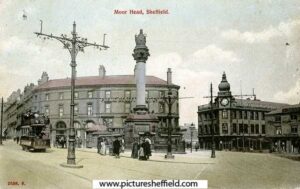
Sheffield Crimea Monument 1905
The Crimean War was the first overseas conflict in which progress was widely reported in newspapers at home. The graphic detail of the battles, the suffering of the troops and the heroism of the nurses captured the public imagination to a very significant degree. When hostilities ceased there was a nation-wide interest in acknowledging and commemorating those who had participated and those who had lost their lives.
Contemporary newspaper accounts suggest that in Sheffield there was considerable support for the erection of a public memorial. In 1857 the Town Trustees donated a piece of land at Moorhead (town end of South Street) as a site on which such a monument might stand. Two Russian cannons captured at Sebastopol were donated to the town by the government. They were used at fundraising events and later placed at the foot of the monument.
However, the early plans foundered until February 1860 when a new planning committee was set up, headed by the mayor, aldermen and councillors. An advertisement was launched for designs and in July 1861. It was decided accept a plan submitted by the architect George Goldie of London. This consisted of a base of Darley Dale Stone supporting an eighteen foot column of Aberdeen granite which was topped by a ten foot statue of Queen Victoria as “Honour”, sculpted by Henry Lane of Birmingham. The cost was £400.
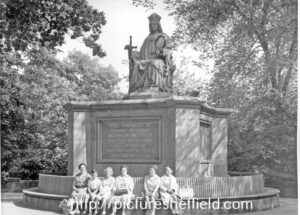
Crimea Memorial 1961
The monument was unveiled in 1863 and formed a striking landmark in the town centre until 1960. Sheffield was undergoing a period of post-war redevelopment and the monument was taken down to facilitate traffic management. The statue was relocated to the Botanical Gardens where it was installed on its plinth. For the first time local people could actually view the sculpture at close range. The granite pillar was cut up into a series of circular disks and placed as a memorial to the Crimea in a green space in Addy Street. The fate of the cannons is unknown. They had already disappeared by 1926.
In 2004 the neglected Botanical Gardens received a grant towards its restoration on condition that it be returned to its original state, as it was when it was designed in the 1830s. There was no place for the anachronistic Crimea Memorial and so it was taken into Council storage where it has remained eversince.
You can find a number of photographs of the Crimea Monument on Picture Sheffield in its two locations at Moorhead and the Botanical Gardens. It remains possible to visit the memorial in Addy Street created from the column.